The proverb “Caesar’s wife must be above suspicion” was widely discussed in media when the then Prime Minister Dr. Manmohan Singh used this expression while aggressively defending himself against allegations in allocation of 2G spectrum at a conclave of Congress Party in December,2010. He had said “I sincerely believe that like Caesar’s wife, the Prime Minister should be above suspicion and it is for that reason that I am prepared to appear before the PAC even though there is no precedent to that effect.” This proverb means that associates of public figures must not even be suspected of wrongdoing and those in positions of authority should avoid even the implication of impropriety.
Julius Caesar was a celebrated Roman General and Statesman who decisively changed the course of Roman history. His conquest of Gaul ( France, parts of Belgium, Western Germany and Northern Italy) extended the Roman world all the way to the Atlantic Ocean, and he was also responsible for the first Roman invasion of Great Britain in 55 B.C.E. Caesar is widely considered to be one of the greatest military geniuses of all times, as well as a brilliant politician and orator. In the early years of his political career, Caesar faced hostility from Sulla who had emerged victor in what can be termed as first civil war of Rome and thereafter controlled Republic of Rome. Caesar’s first wife Cornelia was daughter of Cinna who had opposed Sulla in the civil war. Sulla ordered Caesar to divorce Cornelia but he refused and prudently fled Rome. Sulla later pardoned Caesar and his family and allowed him to return to Rome. However, Caesar chose to serve outside Rome in military service and distinguished himself as a military commander.
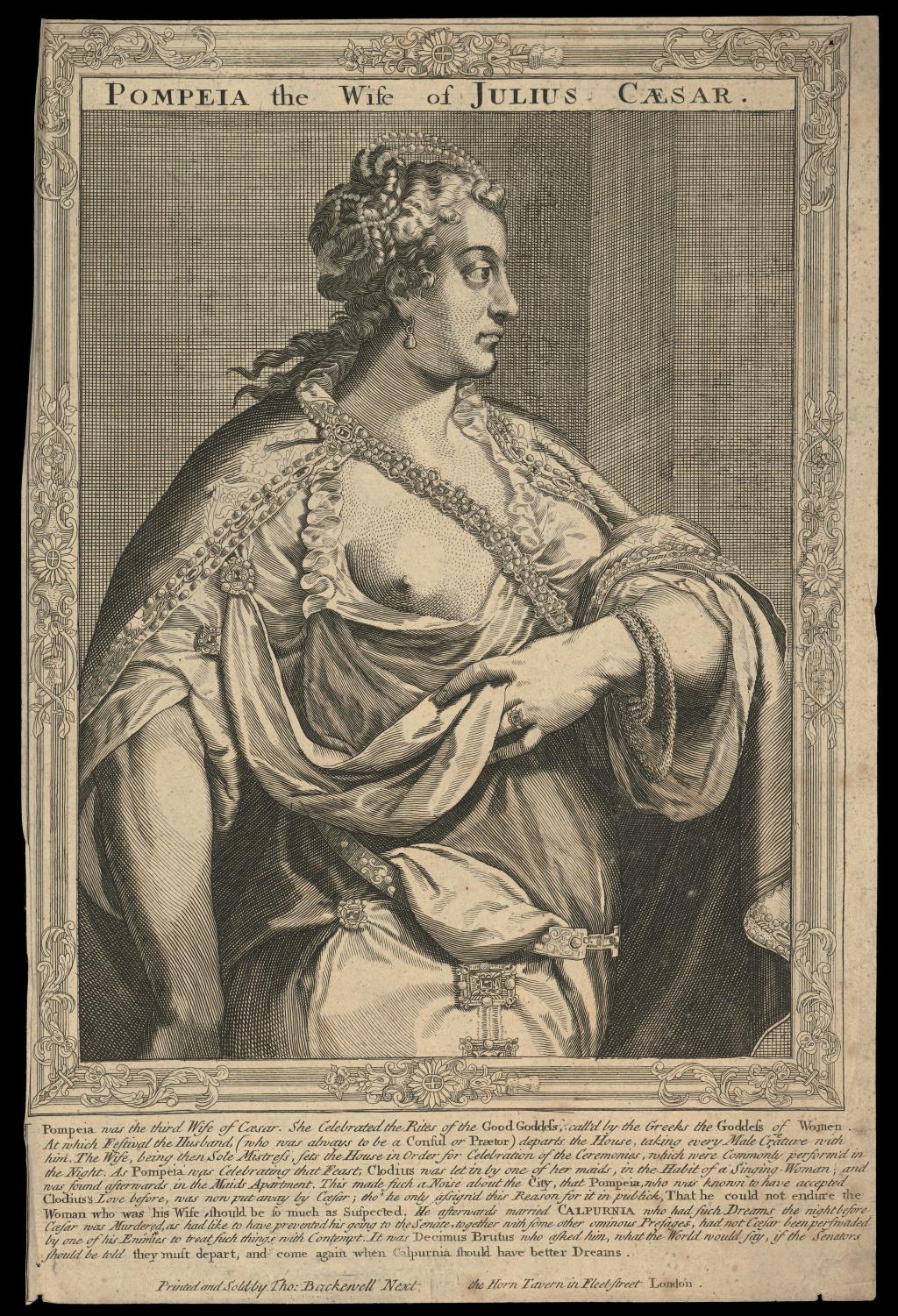
Caesar married Pompeia a year after the death of his first wife Cornelia in 68 BC. Pompeia was the granddaughter of Sulla and it is said that Caesar’s marriage with her was of political convenience. At that time he was trying to build bridges with supporters of Sulla in an effort to break into the uppermost echelons of Roman politics. Neither felt much for the other and she attracted amorous attentions of Publius Clodius, an upcoming scion of an ancient political family.
Ancient Romans celebrated a religious festival, twice every year, dedicated to a feminine deity Bona Dea associated with chastity and fertility. One was held at her Aventine temple and the other was hosted by the wife of a Roman magistrate with imperium. Roman magistrates were elected officials in Ancient Rome. In Latin, imperium means command. A magistrate with imperium had the constitutional authority to issue military and judicial commands. In 62 BC, Julius Caesar’s home was selected for celebration of the annual religious ritual dedicated to Bona Dea. Men were barred from attending this ritual and her worship was so cloaked in secrecy that male authors of that period had very limited knowledge of her rites and attributes. Julius Caesar’s home was chosen for celebration, that year , for two reasons – in that year he served as Praetor which was the junior most office with the power of imperium and second, because in 63 BC he had been elected by the Roman people to hold the office of pontifex maximus, the priesthood which essentially made Caesar the most important religious official of the Republic of Rome. Publius Clodius intruded the house of Caesar dressed as a woman, allegedly with the purpose of seducing Pompeia. Clodius was discovered by Aurelia (mother of Julius Caesar) and he barely managed to escape. News of the scandal spread rapidly and caused considerable disquiet. Some believed that the intrusion of Clodius into an all- female religious festival had the connivance of Pompeia and in fact, she had used this occasion as a cover to arrange a tryst with her lover. Clodius had many political enemies and they used this scandal as a pretext to charge him with desecration which carried death sentence.
This incident caused Caesar huge embarrassment and he promptly divorced Pompeia by written notification no less, for he refused to have a personal confrontation with the woman who had so besmirched his public standing. However, when Clodius was tried, Caesar refused to testify against him. When questioned by the surprised prosecutor as to why he divorced Pompeia, Caesar issued the famous dictum that he had done so not because she had actually done anything wrong but because “Caesar’s wife must be above suspicion”. Clodius was acquitted by the jury.

 Pages from History