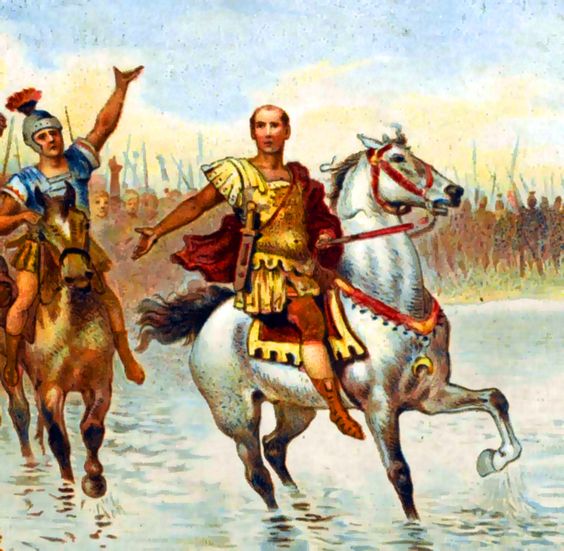
Julius Caesar is associated with famous metaphor “Crossing the Rubicon” which means passing a point of no return. The river is relatively narrow and shallow and now it is identified as a stream. It was the natural border between Cisalpine Gaul, a Roman province to the north, and Roman-controlled Italy to the south. Sometime around 10 January, 49 BCE, Julius Caesar led his XIII Legion of army across the Rubicon leading to four years of civil war in which he emerged victorious and he was declared dictator for life.
The Roman Senate and elected consuls controlled Italy during the Republican period. Each outlying province was managed by a governor appointed by Senate. Governors of the provinces held “imperium” or “the right to command,” making them generals of the army stationed in the region. The paid and professional soldiers were loyal to their generals rather than the Republic. A governor entering into Rome with his army was a threat to the elected rulers of Italy. As a result, the law prohibited governors from entering Italy with their armies. If an appointed governor from a province entered Rome, he had to forfeit command of his troops, otherwise both the governor and the members of his legion would be considered traitors and were liable to be prosecuted under Roman law.
In 58 BCE, Julius Caesar was appointed governor of Cisalpine and Transalpine Gaul for a term of five years which rolled on for another five years. He was able to defeat and subdue Celtic and Germanic tribes in Gaul through his masterful militaristic skill. It enabled him to gain a military reputation, an army devoted to his person, and unlimited material resources. He rose as a popular leader with both his army and the masses. Caesar himself undertook to explain to the Roman people the importance of his task in Gaul. He was an excellent writer and knew how to address himself directly to his readers. His Commentarii or Military Report , written in masterly style, told from year to year the story of his operations in Gaul. The years when Caesar was in Gaul were years of violent political disturbances at Rome. Therefore, his victories and the growing halo around him were perceived as a threat by the Senate, his old enemies and also his new friends, Pompey and Crassus. As his term as governor wound to a close, the pressing question was how he would be reintegrated into mainstream Roman politics. Returning to Rome as a private citizen would have provided a window for a prosecution, among other things over the questionable legality of his acts of mass killings in Gaul. Therefore, Caesar insisted that he should be allowed to stand at the consular elections without appearing in person at Rome and without laying down his proconsular powers. In December of 50 BCE Senate voted by overwhelming majority that Caesar give up his command of Gaul. As a result, Caesar was legally obligated to return to Rome as a private citizen.
On 7 January 49 BC, the Roman government formally demanded that Caesar hand over control of his army and transfer his governorship to his successor. Three days later, Caesar was in Ravenna, near the border, contemplating his next move. Ultimately, he led his XIII Legion across the Rubicon, crossing from Cisalpine Gaul into Italy. Caesar was contemplative at the time of his crossing. He heavily weighed the choice before resolving to enter Italy and advance to Rome. Caesar quoted a phrase in Latin “alea iacta est” which means “ The die is now cast.”
Caesar’s supporters in Rome rushed to join him in Northern Italy and Pompey was pushed into leading the ‘anti-Caesarian’ forces. Pompey fled Rome and decided to fight from his power base in the East. In 48 BCE, Julius Caesar decisively defeated Pompey at Pharsalus in Northern Greece. Pompey sought refuge in Egypt where he was assassinated. However, it took Caesar few more years to crush his adversaries. Finally, in 45 BCE, Caesar was left without a rival and with an army admirably trained and absolutely devoted to him. He chose a new Senate which was completely subservient to him. He was declared dictator for life but his life was cut short with his assassination by a group of senators during a meeting of the Senate in Rome on 15 March, 44 BCE.

 Pages from History