Phrygia was an ancient Anatolian kingdom (12th-7th century BCE) which is now part of modern day Turkey. The fertile plain of the western side of Anatolia attracted settlers from an early period. The Balkan immigrants to this area were referred to as Phrygians by the Greeks and this area came to be known as Phrygia. The kingdom’s traditional founder and first king was Gordios, a legendary figure who is remembered today as the creator of the ‘Gordian Knot‘, a fiendishly difficult piece of rope-work he had used to tether his cart. It had been foretold by an oracle that the person who untied the knot would rule over all of Asia.
Gordius was an ordinary farmer. One day while he was ploughing his field, an eagle landed upon his yoke and remained there till the evening. Gordius considered it an omen and decided to get it interpreted by the soothsayers. He accordingly went to a neighbouring town Telmissus in order to consult the soothsayers, who were very celebrated for their art. Close by the gates of the town he met a girl who herself possessed prophetic powers. Gordius fell into conversation with her, and related to her the occurrence which had interested him so strongly. She advised and also consented to accompany him to offer a sacrifice to Zeus (the king of gods) at Telmissus. The affair ended in her becoming his wife, and they lived together in peace for many years upon their farm.
Phrygians were in a state of great consternation on account of the civil dissensions and contests which prevailed in the country. They convened an assembly to seek the oracle’s advice regarding a solution to the prevailing problem. The oracle said that the king who would put an end to their troubles was approaching in an oxcart. Just then Gordius appeared in his oxcart with his wife, his son Midas driving the cart. The assembly thought at once that this must be the cart the oracle had referred to, and they made Gordius king by acclamation. In gratitude, Gordius dedicated his ox-cart to Zeus, tying it to a post with a knot so complex and intricate that nobody could figure out how to untie it. It became known as the Gordian Knot. His son Midas is the same king who according to the Greek mythology had acquired golden touch from the god Dionysus, only to regret it later when he began to starve as the food and drink he touched also turned into gold. Midas went to Dionysus and begged him to revoke the gift of golden touch. Dionysus granted king Midas release from his gift of golden touch by having him bathe in river Pactolus, an action to which the presence of alluvial gold in that stream is attributed. Contrary to the moral of the story, today the term “Midas touch” is used in a positive way. It means ability to make money out of anything one undertakes.
Alexander became the king of Macedonia in 336 BC at a very young age of 20. His father King Phillip had been able to conquer and unite Geek city-states and his next goal was to subdue Persia, the age-old enemy of Greece. But Philip was assassinated before he could pursue his second goal. From his accession Alexander had set his mind on the Persian expedition. However, his interest was not limited to military conquests, his army was accompanied by surveyors, architects, engineers, scientists and historians. He was inspired by the story of Achilles and the fall of Troy and carried a copy of Homer’s Illiad with him wherever he went. Alexander was deeply interested in history and mythology. Alexander accordingly resolved that his first landing in Asia should be at Troy. From here he advanced without opposition till he reached the banks of little river Granicus. The Persians had assembled in vast numbers on the opposite shore to block the advance of Macedonian army. The coolness, courage and strength of Alexander’s army carried the day and Persians fled in all directions. From here, Alexander moved along on the eastern shores of Aegean sea. He faced little opposition as it was hardly a Persian territory and the inhabitants were mainly of Greek origin. With the onset of winter, Alexander decided to slow down his campaign. He allowed those who had been married within a year to go home, spend winter time with their bride and join back at the city of Gordium. During winter time, Alexander conquered western Asia Minor, subduing the hill tribes of Lycia and Pisidia. His next major campaign was to start in Spring, from the city of Gordium.
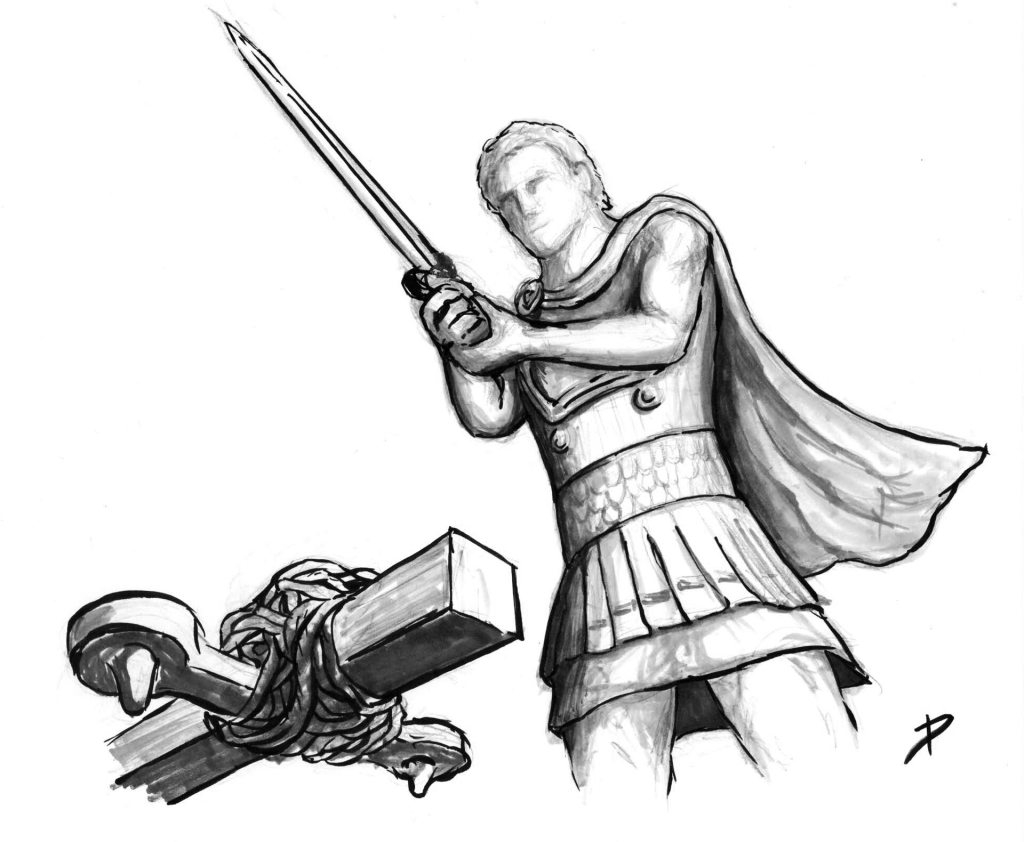
One reason why Alexander decided to go to Gordium was that he wished to untie the famous Gordian knot. He had heard about the prophecy that whoever could unfasten the knot would go on to rule over Asia . He had been seized by a longing to test the prophecy. He went into the temple where the cart of Gordius had been deposited. After looking at the knot, and satisfying himself that the task of untying it was hopeless, he cut it to pieces with his sword. The phrase “cutting the Gordian knot” has thus come to denote a bold solution to a complicated problem. Today, the term “Gordian knot” means any perplexing problem. Arriving at a quick, bold solution is known as “cutting the Gordian knot.” The prophecy that the person who untied the Gordian knot would rule over all of Asia turned out to be true as Alexander went on to establish the largest empire the ancient world had ever seen.


 Pages from History