It is believed that the religion of Islam was revealed through divine revelations to Prophet Muhammad who was a religious guide as well as a military leader. He managed to unite most of the Arabian peninsula through conquests and conversion to Islam which laid the foundation for subsequent Islamic expansion beyond Arabia. After his death in 632 AD, many Arabian tribes renounced Islam and reverted to their old practices of polytheism. The Muslim community elected his close associate and father-in-law, Abu Bakr, as his successor who took swift military action against these break away groups. These military campaigns, known as ridda or apostasy wars, unified the entire Arabian peninsula under Islamic rule. Abu Bakr took the title of Caliph and formed the basis of Islamic Caliphates. He was the first of the four initial caliphs referred to as Rashidun Caliphs. During the Rashidun period, the Islamic army conquered the Levant region, Egypt, parts of North Africa and the whole of Sassanian empire. The new religion spread quickly through military conquests. Ali, son-in-law of the Prophet, was the fourth and the last Rashidun Caliph. Civil war erupted during his rule resulting in his murder and establishment of Umayyad Dynasty in 661 CE. The Islamic empire continued to expand under Umayyad dynasty despite internal dissensions and revolts. After having consolidated hold on North Africa, the Arab armies launched conquest of Iberian peninsula ( present day Spain and Portugal) with the battle of Guadalete in 711 CE in which Gothic king Roderic was defeated and killed. After conquering and consolidating hold on Iberian peninsula, the Arab army was poised for further expansion into Western Europe. In 719 Islamic army crossed the Pyrenees ( a mountain range between Spain and France) to capture Narbonne ( a town in modern day France) and by 725 CE all of Septimania (an area in southern France) was under Arab rule. These developments were quite alarming to West European countries as they feared that the Umayyad Caliphate would first plunder and then force them to convert to Islam.
Attempts of the Umayyad Caliphate to penetrate further into western Europe brought them in conflict with the kingdoms and dukedoms of present area of France and Germany. These small kingdoms and dukedoms of western Europe were almost always at war with each other and ill-prepared to face the larger threat of the Umayyad caliphate. A strong unified European kingdom was the need of the hour and Charles Martel, a Frankish statesman and military leader, carried out this task successfully. Charles was son of Pippin II from his second wife or mistress Alpaida. Pippin II, commonly known as Pippin of Herstal, was the de facto ruler of Francia as the Mayor of Palace. When Pippin died in 714 CE, his first wife Plectrude imprisoned Charles and tried to assure the throne for her grandson. Charles soon escaped and after winning several battles installed his own puppet king and made himself ‘Mayor of the Palace’, the power behind the throne. Eudes or Odo the Great, Duke of Aquitaine continued to pose challenge to the supremacy of Charles in the Frankish region. He had defeated Umayyads in 721 CE in the Battle of Toulouse. This victory had greatly enhanced his prestige and earned him the epithet “the Great”. However, his resounding defeat at the battle of the River Garonne near Bordeaux in 732 CE by Umayyad army forced him to seek assistance from Charles and acknowledge his overlordship. Charles certainly did not want plundering and subjugation of Europe at the hands of a foreign religion and therefore, decided to fight together with Eudes against the Umayyads. The Umayyad army spent months plundering Bordeaux giving Charles time to assemble a force and prepare for the battle. After Bordeaux, the next possible target of Umayyad forces was Tours, the most prestigious, richest and the holiest Christian shrine in western Europe at that time.
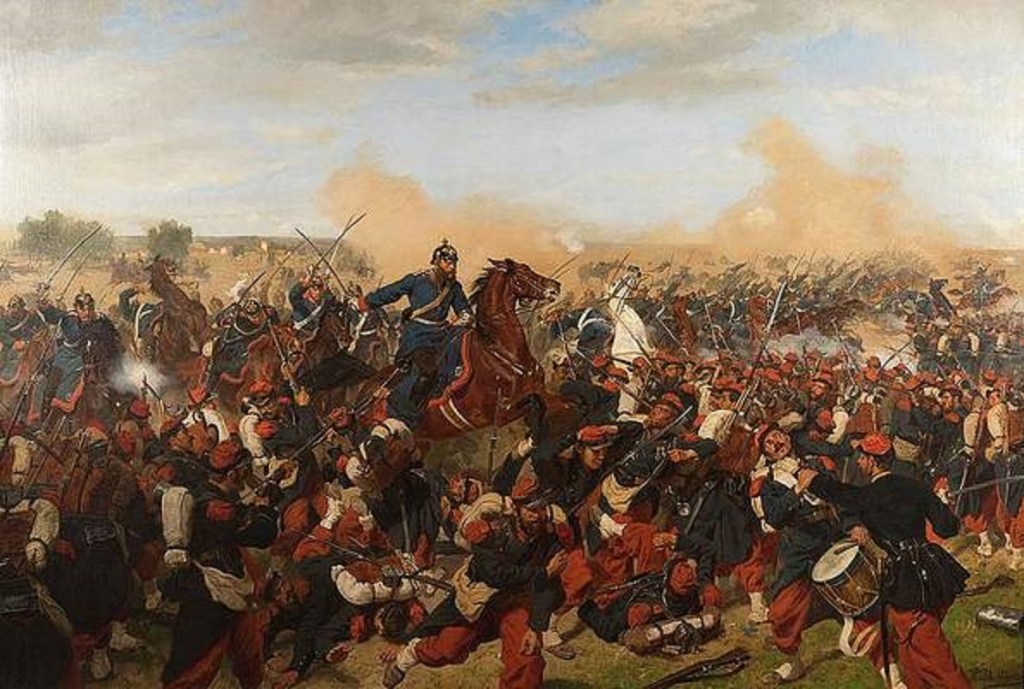
Charles collected his army of an estimated 50,000-75,000 veterans and marched south to take on his foes. He avoided old Roman roads to take his foes by surprise. The superiority of Umayyad forces lay in armored cavalry which had been made possible due to use of stirrups which the European cavalry lacked. The European forces still relied heavily on infantry and it was almost impossible for the medieval infantry to withstand the charge of armored cavalry in an open battle field. Therefore, Charles placed his men on a high wooded plain to blunt the cavalry charge. The invading Umayyad forces were caught entirely off guard to find a large, well-disposed force blocking their way to the city of Tours. It became a waiting game for both the armies as the Umayyad general Abd er Rahman wanted the Franks out in the open and the Franks wanted their opponents to come uphill. The proverbial first to blink in this contest of wills was Abd er Rahman. The Umayyad cavalry charged but it could not break the defensive phalanx like formation of Franks. In the midst of the battle, scouts from the Franks raided the Umayyad camp. Many of the Umayyad cavalrymen rushed to the camp to save their plunders from Bordeaux. This, to the rest of the army appeared to be a full-scale retreat and soon it actually became a full-scale retreat. While attempting to restore order among his men, Abd er Rahman was surrounded by Franks and killed. This victory at the Battle of Tours which was fought in the month of October in 732 CE, gave Charles his nickname ‘Martel’ meaning hammer.
Christian contemporaries have carefully recorded this battle and keenly spelt out its implications. This battle is considered by many as a watershed event which influenced the fate of Christian civilization in Europe. However, some modern historians now downplay its importance. They point out that Arab forays continued even after this battle and it finally ended due to internal dissensions within Caliphate and therefore, this battle was not as important and decisive as it is made out to be. Some of them even go to the extent of dismissing this battle as a border skirmish which is definitely far removed from the truth. It should also not be forgotten that had Charles Martel fallen, Arabs would have easily conquered a divided Europe. After this battle, Charles Martel learnt the technology of stirrups from his foes and used it to develop armored cavalry which he used in combination of his infantry to devastating effect in subsequent battles against Arabs. The threat of Arab invasions finally ended in 750 CE when the Umayyad Caliphate collapsed into civil war.

 Pages from History