
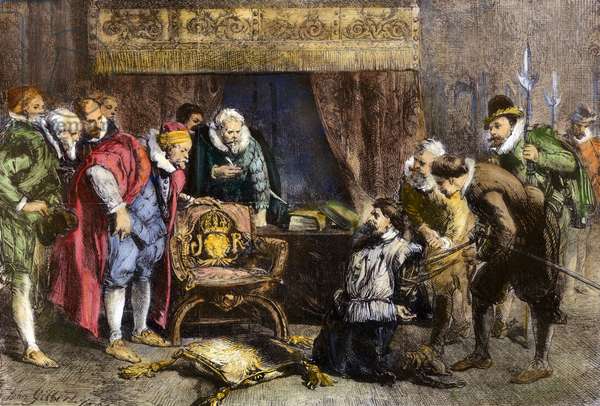
Guy Fawkes being interrogated by King James I and his council
Henry was the second son of King Henry VII of England but he became heir to the throne when his elder brother Arthur died in the year 1502 CE. He ascended the throne in the year 1509 CE and soon after his accession married Catherine of Aragon, widow of his brother. Catherine bore him six children but only one girl child survived. King Henry VIII was desperate for a male heir and he wanted to marry Anne Boleyn, one of the ladies of the court. To marry Anne Boleyn, King Henry VIII had to divorce Catherine. When he failed to get the approval of Pope to divorce Catherine, he decided to break away from the Roman Catholic Church. English Parliament passed the Act of Supremacy in 1534 making King of England the Supreme Head of the Church of England. The split between Church of England and the Roman Catholic Church paved the way for Protestantism to grow in England.
The Church of England became wholly Protestant during the reign of King Edward VI who succeeded King Henry VIII in the year 1547 CE at the very young age of nine. However, his rule lasted for only six years and the Protestant Reformation in England received a setback when his Catholic sister Mary I ascended the throne. She earned the nickname “Bloody Mary” due to execution of hundreds of Protestants in the aftermath of a failed Protestant rebellion. Her rule lasted for just five years and she was succeeded by her half sister Elizabeth who was a Protestant. England returned decisively to Protestantism under her rule and rebellion against her by Catholics resulted in their persecution and harsh anti-Catholic measures. Her successor King James I was also a Protestant but he was expected to treat Catholics better as his mother was a Catholic and his wife was a Catholic convert. King James I initially appeared tolerant towards English Catholicism but after surviving two Catholic plots against him in the early years of his reign, he turned hostile towards them. In a speech to Parliament in early 1604 CE, King James I said he detested the Catholic faith and a day later he ordered all Catholic priests to leave his kingdom. When the hopes of Catholics for a better treatment under King James I were dashed, then Robert Catesby, a Catholic zealot, started planning to eliminate him.
Robert Catesby was born in a prominent Catholic family of England and his father had suffered financial penalties due to refusing to conform to the Church of England. In 1601 CE Robert Catesby was imprisoned and fined for having been involved in the doomed rebellion of Earl of Essex against the dominance of Robert Cecil, the chief advisor of Queen Elizabeth I. Upon his release he became involved in instigating Spanish government to invade England and he was imprisoned again for a brief period. Robert Catesby decided to take matters in his own hand after sensing correctly that Spain was edging towards peace with England. In 1604 CE he started working on a plot to murder the king along with his ministers by blowing up the Parliament. He hoped that the confusion that would follow would provide an opportunity for the Catholics to take over the country.
Robert Catesby along with his four close associates – John Wright, Thomas Winter, Thomas Percy and Guy Fawkes formulated the plan to blow up the Parliament and later several other persons were included in the plot. Guy Fawkes was a military veteran who had fought for the Spanish army in the Eighty Years War – the war of Netherland’s independence from Spain. He brought with him the required expertise in tunneling and handling of explosives. The conspirators hired a house in Percy’s name adjoining the House of Lords and tried to dig a tunnel in which they could plant gunpowder. However, they discovered a cellar directly underneath House of Lords and they managed to rent it in March, 1605. After a series of postponements, the Parliament’s opening was finally set for 5 November, 1605 and by then the plotters had managed to put in place 36 barrels containing 2500 kilogram of gunpowder. This amount of gunpowder was enough to kill everyone within a radius of 100 metres and to raze to the ground everything within a radius of 40 metres. The plan to blow up the Parliament was all set to succeed but an anonymous letter delivered to Lord Monteagle revealed the plot. The letter warned him not to attend the opening ceremony of the Parliament. Lord Monteagle was a Catholic but loyal to the King. He immediately warned the authorities and a search of Parliament was ordered. In the early hours of 5 November, 1605 Guy Fawkes was discovered in the cellar with 36 barrels of gunpowder. Guy Fawkes, under torture, revealed the names of his co-conspirators and associates all of whom were either captured or killed. All the captured conspirators were tried and found guilty of high treason. They were sentenced to death by being hanged, drawn and quartered which meant they were hanged, disemboweled while still alive and then beheaded and dismembered.
Although Robert Catesby was the leader, Guy Fawkes became the name associated above all others with the infamous gunpowder plot. The reason perhaps is that he was the one caught red-handed. The failure of gunpowder plot backfired on Catholics of England as it led to increase in the severity of laws against Catholics. Catholics were banned from becoming officers in the armed forces and working in the legal profession. They were also banned from voting and becoming Member of Parliament. In general, the gunpowder plot hampered the atmosphere of religious tolerance in England.
In 1606 Parliament declared November 5 as a national day for thanks giving and every year this day is celebrated by the British as Guy Fawkes Day with a big bonfire, fireworks and burning of effigies of Guy Fawkes. Another tradition associated with the failure of gunpowder plot that still continues is the ceremonial search by the Yeomen of the Guard* before the State Opening of Parliament.
*Yeomen of the Guard – Yeomen of the Guard is the oldest existing military corps in Britain. They are responsible for guarding the Royal Palace.

 Pages from History