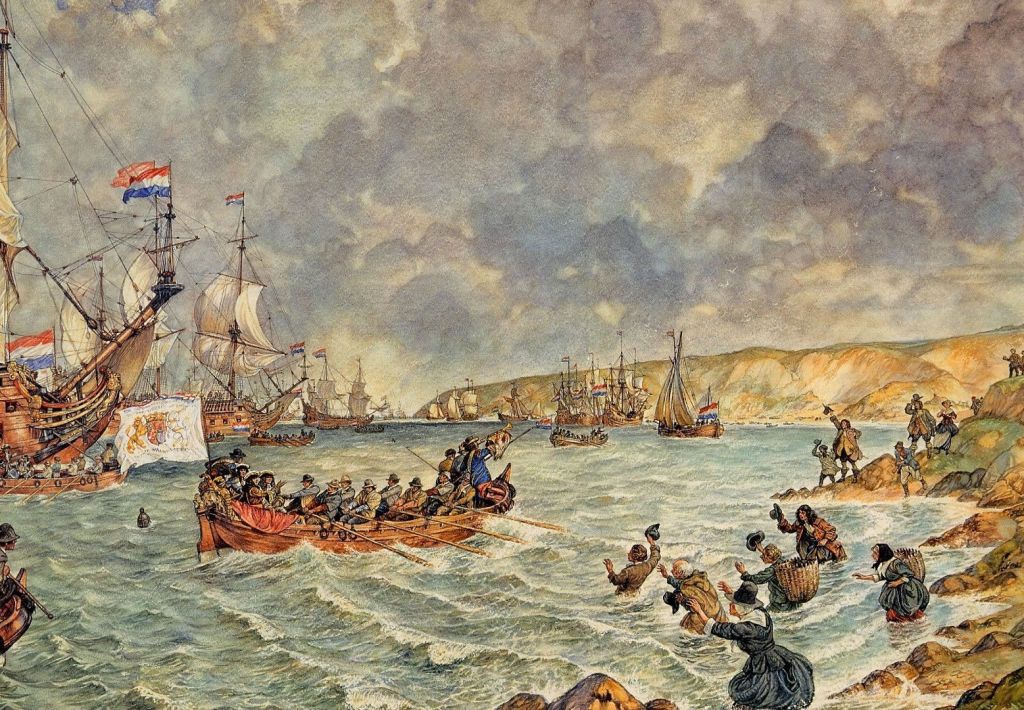
England witnessed the public execution of King Charles I in 1649 following the defeat of supporters of monarchy in the civil war. Monarchy got abolished and Parliament formed a republic under the leadership of Oliver Cromwell. Cromwell died in 1658 and he was succeeded by his son who lacked the qualities of a charismatic leader. The nobles began plotting to bring back Charles II, the exiled son of Charles I, to claim the throne. In 1660 Charles II returned to England and claimed the throne without much opposition. James II, the younger brother of Charles II, also returned to England after restoration of monarchy and he became lord high admiral during Anglo-Dutch Wars. James II converted to Catholicism in 1668 and in 1673 when Parliament passed the Test Act, he resigned as lord high admiral rather than take an anti-Catholic oath imposed by the Test Act. Charles II remained childless and the prospect of Catholic James II becoming the King created an alarm in the general public. Parliament had excluded him from succession in 1679 but King Charles II had him reinstated with the condition that his two surviving children, Mary and Anne, were raised as Protestants. In the year 1685, James II ascended to the throne without much overt opposition despite widespread apprehension about his Catholic faith.
Initially, the Parliament fervently displayed loyalty towards James II and voted for life the same revenue which his predecessor Charles II had enjoyed. Parliament also granted him emergency military aid to suppress the rebellion in 1685 by James Scott, duke of Monmouth who was an illegitimate son of Charles II. The size of the army was increased, dispensing with the Test Act of 1673, James II appointed Catholic officers to command the new regiments and the rebellion was crushed swiftly. James II made it clear that he intended to maintain the increased size of the army, repeal the penal laws against Catholics and appoint them to the positions of power. James II adjourned the Parliament in November, 1685 when it refused to repeal the Test Act and declined the extra money demanded for maintaining the increased size of the army.
In April, 1686 a case was brought by Mr. Godden against Sir Edward Hales, a Catholic convert, who had assumed command of a regiment without taking the required oath under the Test Act. This was a collusive case as Mr. Godden, a servant of Sir Edward Hale, was acting on the instruction of his master. Sir Edward Hale was convicted and he appealed against this verdict in the Court of King’s Bench. The Court ruled that King had the power to dispense with penal laws in individual cases. James II then systematically set out to appoint Catholics at levels of the Government including posts within the Anglican Church. In April 1687, he issued a Declaration of Indulgence which suspended penal laws against religious minorities including Catholics and then he dissolved the Parliament in July, 1687. Officially, the Declaration of Indulgence aimed at providing religious freedom for minorities and creating an atmosphere of religious toleration but his Protestant subject perceived it as a means to promote Catholic faith leading to their further alienation.
The main issue with the rule of James II in England was his Catholic faith and its aggressive promotion. Despite widespread resentment, the moderates among his opponents had been calling for restraint as they expected Mary (a Protestant) to soon succeed the ailing King. The situation changed when on 10 June, 1688, the Queen of England gave birth to a son who was baptized according to Roman Catholic rite and a Catholic dynasty seemed imminent. Opponents of James II knew that they must act now or never. On 30 June, 1688 a letter was sent to Prince William of Orange (husband of Mary and son-in-law of James II) inviting him to become King of England. This letter of invitation was signed by seven prominent English noblemen who later became known as the ‘Immortal Seven’. In fact, William had already built up a sizable navy to intervene in the matters of England and this letter of invitation served as a favorable “Protestant wind”.
Prince William landed unopposed with an army of 15-20,000 men in Devon on 5 November, 1688. James II still had his standing army but the enthusiastic welcome of William and desertions of his prominent supporters broke his will to fight. William entered London on 19 December, 1688 and James II fled to France. He died in exile in 1701.
On 22 January, 1689 a new Parliament, known as Convention Parliament, met. When Parliament assembles without formal summons of the monarch, it is known as Convention Parliament. The official line was that James II had abdicated and 23 December, 1688, the day on which he had left English shores was considered as the day of his removal. A group of members in the House of Lords wanted Mary to rule alone as this would have preserved the tradition of succession. However, this was not acceptable to William and as a compromise crown was offered jointly to William and Mary. The offer of the crown was on the condition of acceptance of ‘Declaration of Rights’. William accepted this condition. William of Orange became William II of England and his wife Mary became Mary II of England via a decree by Parliament on 13 February, 1689. Thereupon, Convention Parliament turned itself into a proper Parliament and ‘Bills of Right’ incorporating the provisions of Declaration of Rights was passed. It barred Catholics from the throne, abolished the crown’s power to suspend laws and dispensing with laws. James II had been forced to abdicate without any battle or bloodshed and therefore, this change of regime became known as ‘Bloodless Revolution’. This revolution is also called ‘Glorious Revolution’ because it had preserved the existing institutions of power, however, the balance of power between the institutions had changed. The ‘Glorious Revolution’ permanently established Parliament as the ruling power of England.

 Pages from History