Wars of the Roses
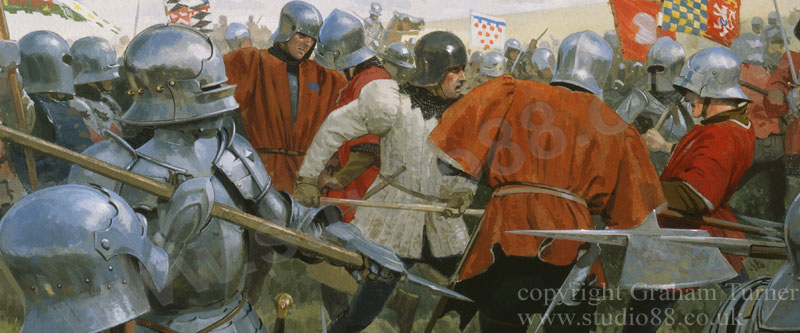
The Wars of the Roses was a series of dynastic civil wars in England between two groups – Yorkists and Lancastrians. Both groups claimed the throne through descent from the sons of Edward III. Edward III was the king of England from 1327 to 1377. He is best remembered for having led England into Hundred Years’ War with France. He was succeeded by his grandson Richard II because his eldest son and heir apparent Edward, Prince of Wales (later known as the Black Prince) had died one year before him. When Edward, Prince of Wales died in 1376, Parliament feared that his younger brother John of Gaunt, Duke of Lancaster might usurp the throne and therefore, it quickly invested his son Richard II as Prince of Wales. Richard II was crowned on 16th July, 1377 after the death of Edward III. He was then a minor and three ‘continual councils’ lasting from 1377 to 1380 were responsible for governance of his kingdom. They are known as continual council because their members were supposed to be continually available to provide advice and guidance to the king’s government. John of Gaunt, Duke of Lancaster exerted considerable influence on matters of importance despite not being a member of any of these continual councils and remained a threat to the minor king in the early years of his reign. In 1399 Henry Bolingbroke, son of John of Gaunt, deposed Richard II and became King Henry IV of England, the first Lancastrian King. Henry’s successful usurpation did not lead to his general recognition of claim and he continued to face attacks from formidable groups of domestic and foreign enemies. In 1413 Henry IV died and was succeeded by his son Henry V. Henry V was succeeded by his nine months old son Henry VI in the year 1422. Nine months old baby as a king inevitably meant a long period of regency leading to intrigues and jostling for power at court.
Henry VI assumed full royal powers at the age of sixteen, however, he remained a non-entity. He was timid, shy and also suffered repeated bouts of crippling mental conditions. During his reign England suffered major setbacks in the Hundred Years’ War. Situation in England was anarchic, crown was weak and local chiefs with private armies dominated the countryside. England needed a strong and capable Government which Henry VI failed to provide. Such a situation emboldened the opponents of House of Lancaster who had for long been secretly contending that a usurpation had been forced upon them. Their hope of removing the usurper was embodied in Richard, Duke of York. As the great grandson of Edward III, he was the only other person besides Henry VI with an unbroken male descent from Edward III. His hereditary claim to the throne, by primogeniture, was stronger than that of Henry VI.
Henry VI suffered a nervous breakdown in July, 1453. His queen Margaret of Anjou was ambitious and during Henry’s imbecility claimed the regency but her rule was so unpopular that in March, 1454 Parliament appointed Richard of York Protector of the realm. Richard set to work with cool vigour to restore order and provide good government but his rule was short-lived. At Christmas 1454 Henry VI recovered and Richard ceased to be the Protector. Henry re-established the authority of supporters of Margaret and Richard was forced to take up arms in self-protection. On 22 May, 1455 Richard and his allies defeated the royal forces at St. Albans and took Henry VI prisoner. St. Albans was the first shedding of blood in the series of dynastic conflicts which were named ‘Wars of the Roses’ afterwards. Richard once again became Lord Protector but he continued to rule in the name Henry VI and an uneasy truce continued. In 1459 Richard fled to Ireland when Yorkist forces got scattered after a skirmish at Ludford Bridge. In 1460 the Yorkist forces under Earl of Warwick defeated the Lancastrians at Northampton. A so-called compromise was reached. Henry was to be king for life; Richard was to conduct the government and succeed him at his death. The King in bondage had disinherited his own son and Yorkist victory appeared to be complete and final. However, Queen Margaret, with her son, was at liberty in Wales and she fought on.
The Lancastrians forces under Queen Margaret surprised and defeated the Yorkist forces at Wakefield on December 30, 1460. Richard of York was killed in this battle. The Lancastrian forces then advanced towards London and defeated Yorkist forces under Earl of Warwick at the Second Battle of St. Albans on February 17, 1461. Meanwhile Richard’s eldest son and his heir, Edward had defeated a Lancastrian force at Mortimer’s Cross on February 2, 1461. Edward entered London with the triumphant army of Mortimer’s Cross and the survivors of the Second Battle of St. Albans on February 26, 1461 and declared himself king on March 4, 1461. He pursued and defeated Margaret at the Battle of Towton on March 28, 1461. Henry, Margaret and their son fled to Scotland. Yorkists had won the first round of the civil war.
The next round of the war arose out of disputes within the Yorkists themselves. King Edward refused to submit indefinitely to the tutelage of Earl of Warwick. Warwick then allied himself with Margaret, deposed Edward and restored the crown to Henry VI in 1470. In April, 1471 Edward regained his kingdom by defeating Warwick in the Battle of Barnet. Warwick died in this battle and Edward’s throne remained secure for the rest of his life. When he died in 1483, his brother Richard, Duke of Gloucester (known as Richard III after becoming king) usurped the throne by declaring his son Edward V an illegitimate child. Edward V and his younger brother later disappeared under mysterious circumstances. This usurpation split the Yorkists and opponents of Richard III turned to Henry Tudor, the sole surviving male with any claim to the house of Lancaster. To unite the opponents of Richard III, Henry Tudor promised to marry Elizabeth of York, eldest daughter of Edward IV. The coalition of Lancastrians and Yorkist deserters aided by the French defeated and slew Richard III at the Battle of Bosworth on August 22, 1485. Henry Tudor was crowned on October 30, 1485 . He married Elizabeth of York on January 18, 1486 and united the house of Lancaster and house of York. Marriage of Henry Tudor with Elizabeth produced the Tudor line in which both Yorkists and Lancastrians had a share and thereby brought the Wars of the Roses to a close.
The popular name ‘Wars of the Roses’ for the dynastic civil wars in England was coined by the novelist Sir Walter Scott in the nineteenth century after the badges of the contending parties- the white rose of York and the red rose of Lancaster.

 Pages from History