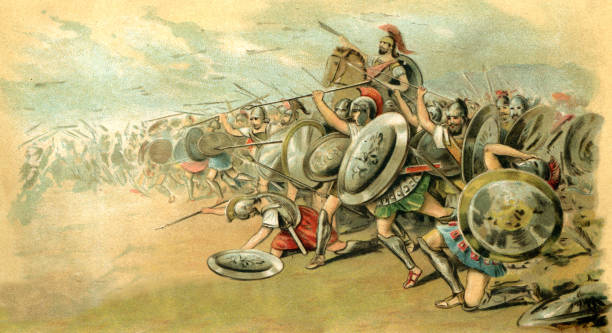
Greco-Persian wars refers to the conflict between the Greek States and Persia during the fifth century BCE spanning over a period of almost half a century. The fighting was most intense during two invasions launched by Persians against mainland Greece. The first invasion came in 490 BCE and the second invasion came in 480 BCE. The Greek States united and successfully resisted the expansion of the Persian empire, the superpower of its time.
Cyrus the Great founded Persian empire which under the rule of Darius I became the largest empire the ancient world had ever seen. Cyrus the Great had conquered Ionia after defeating Croesus of Lydia in 547 BCE. Ionia was a territory in western Anatolia (modern-day Turkey) populated by people of Greek origin. When Ionians revolted against Persian rule in 499 BCE, it received support from the Greek city states of Athens and Eretria. It marked the beginning of the Greco-Persian wars.
After quelling the Ionian revolt in 493 BCE, Darius I decided to conquer the city states of the mainland Greece in order to exact revenge and secure the stability of his empire. He sent messengers to them seeking ‘earth and water’ – tokens of submission to Persian authority. Many Greek states simply submitted but Athens and Sparta, the two most powerful Greek city states, executed the Persian messengers and formed an alliance for the defence of Greece. In retaliation, the Persians launched their campaign against Greeks by capturing islands of Rhodes, Naxos, Delos and Eretria, a major city on the island of Euboea. After capturing Eretria, the Persian army landed unopposed at Marathon, about twenty five miles northeast of Athens. Athenians did not receive support from any of its allies except Plataea. Despite being heavily outnumbered, the Athenian army under its commander Miltiades went on an offensive and routed the Persians. The overwhelming victory of Athenians at Marathon in 490 BCE captured the collective imagination of the Greeks and it soon became an almost mythical event. The story of a Greek messenger Pheidippides running non-stop from the battlefield of Marathon to Athens bringing news of Athenian victory inspired the organisers of modern Olympics to introduce a long distance running race- the marathon.
Darius prepared to invade Greece again but this plan never came to fruition due to revolt in Egypt. Darius was succeeded by his son Xerxes I who quickly crushed the revolt in Egypt and resumed preparations to invade Greece. In 480 BCE Xerxes invaded Greece with a vast army accompanied by large naval fleet moving along the coast. Greeks decided to block Xerxes by land at Thermopylae and by sea at Artemisium. Greek army consisting of around 7000 soldiers was led by the Spartan king Leonidas and Xerxes, on the other hand, had anywhere from 1,20,000 to 3,00,000 soldiers. Thermopylae pass was an excellent choice for defence because the constricted battlefield prevented the Persians from utilising their numerical superiority. Xerxes sent envoys to offer the defenders a last chance to surrender their arms and avoid bloodshed. Leonidas famously replied “Come and take them” and the battle commenced. For two days the Greeks defended the pass imposing heavy casualties on Persian forces. However, the balance tilted in the favour of Persia when a traitor by the name Ephialtes informed Xerxes of a path that went around Thermopylae. Leonidas and his soldiers fought to the death with the exception of Thebans who surrendered. The heroic resistance put up by Leonidas soon acquired mythical status amongst the Greeks.
After taking control of the Thermopylae pass, Xerxes advanced into Attica where he captured and burned Athens. The Athenians, however, had evacuated the city by sea. The naval engagements between Greek and Persian navy at Artemisium had resulted in roughly equal losses and the Greek naval commanders then decided to regroup and fight in the Salamis Straits. Narrow body of water at Salamis favoured the heavier but slower Greek ships and it also reduced the advantage of numerical superiority of the Persian navy. The Persian navy was soundly defeated at the battle of Salamis and the surviving Persian ships retreated to Asia Minor. Xerxes also returned to Persia but his army remained in Greece to continue the fight.
The Greeks assembled largest hoplite* infantry ever seen coming from around 20 city states to counter the Persian threat on land. Under the leadership of Spartan General Pausanias, the Greek army defeated the Persians at Plataea ending Xerxes’ ambitions in mainland Greece. Meanwhile the Greek fleet had landed an army at the coast of Ionia which defeated the Persian army in the Battle of Mycale and destroyed the Persian garrison. Greece had emerged victorious in the Greco-Persian wars but Spartans had no intention of going on the counteroffensive. Athens, however, was ready to deploy its naval fleet in support of the Ionians and in 478 BCE, a military alliance called Delian League under its leadership was founded to protect Ionian Greeks. Hostilities between Athens and Persia continued which finally ended with a peace treaty in 449 BCE called the ‘Peace of Callias’ as it had been negotiated by Callias, an Athenian diplomat.
Greco-Persian wars posed existential threat to Greek states and therefore, it is considered a pivotal moment in history for the Greeks but for the Persians it was far less important. The Persian empire as a whole was not shaken by these military reversals. The Persian kings thereafter adopted the strategy of playing Greek states against one another instead of going on direct offensives.
*Hoplite – Heavily armed ancient Greek soldier. He wore a metal helmet, a breastplate; carried a shield, a sword and a long thrusting spear.

 Pages from History