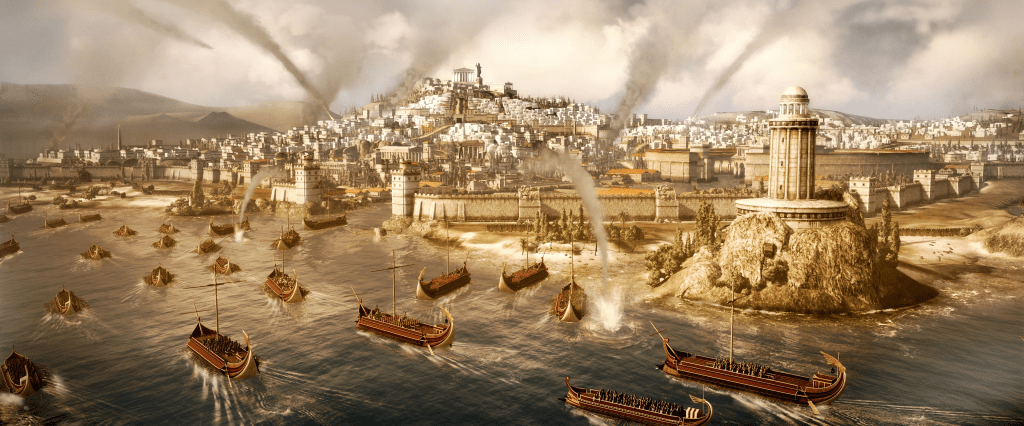
The Second Punic War resulted in defeat of Carthage and this time Romans imposed stricter terms of peace than after the First Punic War. Carthage was forced to give up all its overseas territories and also some of its African territories. The treaty prevented Carthaginians from taking any military action even in self-defense without the approval of Rome. Carthaginians were also forced to pay massive indemnity of 10,000 talents over fifty years. Strangely, deprivation of overseas territories and loss of naval fleet had a salutary effect on its economy. Carthaginians invested in traditional trading and they were able to pay off the indemnity faster than expected without burdening the citizens with extraordinary taxes. Commerce and financial resources of Carthage revived rapidly exciting the jealously of the growing mercantile community of Rome and raising fear among Roman statesmen that it could once again become strong enough to challenge Rome. Carthage took every care to maintain friendly terms with Rome but the hawkish elements in the Roman Senate led by Cato the Elder wanted it to be destroyed. Cato the Elder ended every one of his speeches with the catchphrase ‘Carthago delenda est’ (Carthage must be destroyed) regardless of whether he had been speaking about the city of Carthage.
Numidia, a neighboring kingdom of Carthage, saw an opportunity for territorial expansion after the defeat of Carthage in the Second Punic War. Its ambitious king Masinissa took advantage of his alliance with Rome to plunder and seize Carthage’s territory. The terms of peace treaty with Rome prevented Carthage to take any military action without the approval of Rome and therefore, all they could do was to appeal to Rome for mediation. By the year 150 BCE, Carthage had lost around half of its territory as it had stood in the year 200 BCE. Finally, the patience of Carthaginians ran out when Numidians attacked Oroscopa. They responded by sending an army of 31,000 men commanded by Hasdrubal without the approval of Rome and technically broke the treaty. Although this military campaign turned out to be a disaster for them, Roman war hawks now had the perfect excuse to attack and annihilate Carthage. Hoping to placate the Romans, Carthaginians condemned Hasdrubal and sent envoys to explain their actions but they were coldly rebuffed. Roman Senate approved a formal declaration of war against Carthage and dispatched an expeditionary force under the two consuls Manius Manilias and Lucius Marcius Censorinus. City of Utica had been a long-time ally of Carthage but seeing the writing on the wall, perhaps wisely switched over to the Roman side. Roman forces landed safely at the city of Utica, just 20 miles north of Carthage. Carthage once again tried to mollify Romans and consented to give 300 children taken from most prominent families as hostages. Romans then demanded surrender of all weapons as Carthage was now under Roman “protection” and had no need for weapons. After Carthage had complied with these two conditions, Roman consuls decreed that Carthaginians must abandon their city and emigrate to another place 16 km away from the coast. This condition was too harsh for Carthaginians as it would have made commerce by sea impossible and ruined their economy. They refused to accept this condition and started preparations to defend their city.
Carthage recalled its condemned patriotic leader Hasdrubal and offered him the military command of the city. Makeshift workshops were set up to manufacture weapons which operated day and night without break. Women cut off their hair to make ropes for the new catapults. Carthage was nearly surrounded by water (sea and saltwater lake) and its land boundary was protected by strong defensive walls. Carthaginians managed to successfully resist the Roman onslaught for two years against heavy odds as Romans were unable to completely blockade the port from where the city managed to get resupply through merchant vessels. On top of that, the Carthaginians also kept harassing the Romans by sending out sorties to counter-attack, including fire-ships to set ablaze the Roman fleet.
In the year 147 BCE, a young officer Publius Cornelius Scipio Aemilianus was given full command of the Roman army. He had distinguished himself as a calm and cunning commander on many occasions during this war. He built better siege wall around Carthage and managed to cut off its sources of supplies from overseas. Publius Cornelius Scipio Aemilianus also managed to defeat the Carthaginian troops sheltered at Nepheris which had been ensuring food and supplies for the besieged city. Finally, the Roman troops were able to break through the defenses and captured the city after seven days of brutal street fighting. The soldiers and citizens who still resisted holed up in the temple of Eshmun at Byrsa, a hill protected by steep sides and stone walls. Hasdrubal negotiated with the Romans for his life and agreed to surrender. Wife of Hasdrubal, however, chose death over dishonor. Temple of Eshmun was put to fire and wife of Hasdrubal along with her two sons went to the roof of the burning temple which became their funeral pyre. The three-year long Carthaginian resistance (149 BCE – 146 BCE) ended when the last remaining soldiers also committed themselves onto this funeral pyre. The city of Carthage was burned and ravaged and its surviving citizens were sold into slavery. Roman Senate sent a ten-man commission to carry out series of measures designed to ensure that Carthage remained uninhabited. According to legend, the ground of Carthage was ploughed over and filled with salt so that nothing would ever grow there, however, this tale is no longer considered true. Polybius, a historian and an eyewitness of the destruction of Carthage, records that Publius Cornelius Scipio Aemilianus had publicly lamented the misfortune of Carthage and recited the lines from Iliad – “The day shall come in which our sacred Troy shall fall / And Priam, and the people over whom/ Spear-bearing Priam rules, shall perish all”. Publius Cornelius Scipio Aemilianus had a premonition that the same fate might befall Rome. Yet he obeyed the orders of the Roman Senate and oversaw complete destruction of Carthage like a faithful Roman general. He received a ‘Triumph’ (Triumph was the highest honor bestowed upon a victorious military commander in the ancient Roman Republic) after returning to Rome and became known as Scipio Africanus the Younger.
Carthaginian territory was annexed as a Roman province with Utica as its capital. City of Carthage lay in ruins for over hundred years until it was rebuilt during the reign of Augustus Caesar.

 Pages from History