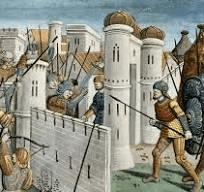
Spanning more than two centuries (1096 -1300 BCE), the Crusades were, in essence, military expeditions organized by western European Christians with the sanction and blessings of Pope in response to centuries of Muslim wars of expansion. Their objectives were to wrest the Holy Lands from Moslem control and to check the spread of Islam.
The First Crusade was called by Pope Urban II in November, 1095 at the Council of Clermont. In March, 1095 Pope Urban II had received requests from Byzantine emperor Alexius I Comnenus for military aid. Byzantine empire was under siege by Muslim Turks and it needed support from West Europe for its survival. Pope Urban II decided to support the Byzantine request as he saw this as an opportunity to unite the Christians against a common enemy and reinforce the power of the papacy. After initial deliberations and preparations, Pope convoked the Council of Clermont in central France on November 18, 1095. In Christianity, a “Council” refers to a meeting of bishops and other church leaders to discuss and decide on matters of doctrine, administration and discipline. After transacting the religious business at the Council of Clermont, on 27 November, 1095 Pope Urban II addressed a great crowd that had assembled in an open field to hear him. He exhorted the French knights at Clermont to free Holy Land from Moslems and promised all participants a remission of their sins, in other words, guaranteed entry into heaven. He closed his speech with the words “God wills it” which became a battle cry of the Crusaders. Disruptions created by the rise of Muslim Seljuks, a Turkish steppe tribe, had made pilgrimage to Jerusalem fraught with danger for Christians and therefore, the response to the exhortation to free Holy Land was immediate and overwhelming. Pope Urban II then embarked on a preaching tour in France to recruit crusaders. Churches and monasteries acted as recruitment centers. The call to “take the cross”, a powerful symbol of Christian faith, was an amazing success. Recruits swore an oath to become a crusader and then wore a cross on their shoulder to proclaim their obligation. The words crusade and crusader are derived from the Latin word crux which means cross.
Pope Urban II had planned the departure of crusader army in August, 1096 but before this, a large number of less-organized bands of peasants and low-ranking knights led by a monk named Peter the Hermit set off for Jerusalem on their own. Their expedition is commonly known as “People’s Crusade”. People’s Crusade was ill-equipped, poorly organized and lacked discipline resulting in unruly behavior and lootings along their way. Peter and his followers reached Constantinople at the end of July, 1096 where they were received cordially by the Byzantine emperor Alexius. Alexius advised Peter to wait for the main crusading force before moving into the territory of Seljuk Turks. The crusaders, however, turned restive and unruly which prompted Alexius to ferry them across the Bosporus (Istanbul Strait) into Asia Minor. By this time, Peter had lost control over his men and he returned to Constantinople to seek additional aid from Alexius. In his absence, his men were ambushed and slaughtered by Turks at the Battle of Civetot. Peter the Hermit’s preaching in Germany had set in motion other groups of Crusaders who also failed to reach Jerusalem. One of these groups led by Count Emicho carried out series of mass murder of Jews in Rhineland before setting off for Jerusalem. These horrific events have even been called “the Frist Holocaust”. After the massacres, this group of Crusaders moved on to Hungary, where they were routed by the Hungarian king. Count Emicho managed to escape and returned home in disgrace.
The main Crusading force consisting of four major contingents set off for Jerusalem in August, 1096 as directed by Pope Urban II. They took different routes to Constantinople and gathered outside the city walls between November,1096 and April,1097. This time Alexios was better prepared to receive the Crusaders and he used them well, despite the rape and pillage perpetrated by less pious members of the Crusading forces. The first major target of Crusaders was Nicaea, a strategically important town in Anatolia. A mixed force of Crusaders and a contingent of Byzantine army managed to capture Nicaea on 19 June, 1097. The Crusade army then left for Antioch in Syria. The march through Anatolia was a difficult journey in the summer heat with limited resources. Horses died in droves during what came to be called the Anatolian Death March. Despite their weakened condition, the Crusaders won a great victory enroute at Dorylaeum on 1 July, 1097. Antioch, one of the great cities of the Levant region, was well fortified and too big to encircle. The siege proved long and arduous but the Crusaders managed to bribe a discontented commander who surrendered his tower and allowed them to enter the city. Crusaders quickly captured the city but the victory was still incomplete. A large Moslem force from Mosul arrived to reclaim Antioch and laid siege to the former besiegers. The city was already very low on provisions and the situation seemed hopeless for the Crusaders. In a last-ditch attempt, they marched out of the city to fight their besiegers. The Moslem forces had only tenuous loyalty to their commander Kerbogha and they fled seeing the size and resolve of the Crusaders.
After capturing and securing Antioch, the Crusaders marched on towards Jerusalem, their ultimate destination. They captured several Syrian port cities on their way and finally arrived at Jerusalem on 7 June, 1099. In August, 1098 the Fatimid Caliphs of Egypt had wrested back Jerusalem from the Seljuk Turks and therefore, the final drive of the Crusaders was against the Fatimids and not the Seljuks. Jerusalem was well protected by massive walls in combination with moats and precipices. The city was well supplied also and therefore, it was expected to withstand the siege till the arrival of a relief force from Egypt. The Crusaders, on the other hand, were short of supplies and considerably reduced in number. The situation was hopeless for the Crusaders until Genoese ships arrived at Jaffa port with food, weapons and more importantly, timber which was used to make siege towers. The Crusaders managed to scale the defensive walls and enter the city on 15 July, 1099. A mass slaughter of Muslims and Jews followed. As the Crusaders consolidated their hold on Jerusalem, information was received that a Fatimid army was enroute to retake the city. Though outnumbered by as much as five-to-one, the Crusaders took the poorly trained Fatimid army by surprise and emerged victorious in the final battle of the First Crusade at Ascalon on 12 August, 1099. The Crusaders had achieved their primary goal of recapturing the Holy Land and with it the site of Jesus Christ’s birth, crucifixion and resurrection. First Crusade led to the establishment of four crusader states in the Levant : the Kingdom of Jerusalem, the Principality of Antioch, the County of Edessa and the County of Tripoli. The County of Edessa was lost in the year 1150 but the remaining three states survived for almost 200 years, providing security to the Christian population in the Middle East. Success of the First Crusade enhanced the prestige of the Pope and increased the role of the Catholic Church in political affairs.

 Pages from History