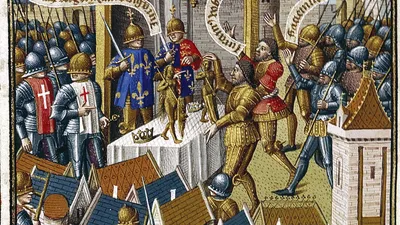
The First Crusade resulted in establishment of four Crusader states in the Levant. These states were the Kingdom of Jerusalem, the County of Edessa, the Principality of Antioch and the County of Tripoli. The County of Edessa was the first Crusader state to be founded and it was also the first to fall. Its fall to the Seljuk Muslim troops in the year 1144 CE was the spark that ignited the Second Crusade. Pope Eugene III, in response to the news of fall of Edessa and pleas for assistance, issued a papal bull on December 1, 1145 CE, calling for a new crusade, known as the Second Crusade. The scope of the Second Crusade was expanded to include reconquest of the Iberian peninsula from Muslim Moors and subjugation of pagan tribes in the Baltic region.
The Crusaders set off in the summer of 1147 CE, the Germans went first followed by the French a month later. French King Louis VII wanted to take the Italian route and transport his army directly to Edessa with the help of Sicilian fleet. However, German King Conrad III distrusted King Roger II of Sicily and convinced Louis to take the overland route which proved to be a disaster. Both, the Germans and the French suffered defeats at the hands of Seljuk Turks in Anatolia before eventually converging in Jerusalem. The Crusaders were persuaded by King Baldwin III of Jerusalem to attack Damascus instead of their main target Edessa. Damascus was the closest threat to Jerusalem and a prestigious prize. The siege of Damascus failed miserably due to bad planning, poor logistics and arrival of a large Muslim relief army sent by Nur ad-Din, the ruler of Aleppo. The Second Crusade completely failed in achieving its main objective of recapturing Edessa. However, it achieved success in its Iberian campaign. The crusaders assisted King Alfonso Henriques of Portugal to capture Lisbon from Muslims. The crusaders also assisted King Alfonso VII of Leon and Castile in capturing the cities of Almeria and Tortosa from the Muslims. Another arena of the Second Crusade was the Baltic and those areas bordering German territories which continued to be pagan. The military campaigns in the Baltic which is often referred to as “Northern Crusades” was aimed at conversion of pagans/non-Christians to Christianity. The Baltic campaign was a partial success in which German, Danish and Polish armies managed to subdue Wendish (West Slavic) tribes.
The Third Crusade (1189-1192) was launched in response to the fall of Jerusalem to Saladin, the Sultan of Egypt and Syria. The Holy City was retaken by Saladin in the year 1187 CE which sent shock waves in Europe and Pope Gregory VIII issued a Crusade bull. Three most powerful monarchs of Europe took up the challenge to reconquer the Holy City : Philip II of France, Richard I of England and the Holy Roman Emperor, Frederick I Barbarossa, king of Germany. Disaster struck the Third Crusade campaign in the very beginning. The Holy Roman Emperor drowned in an accident and then there was a calamitous outbreak of dysentery which resulted in most of the German army either being eliminated or deciding to return home in grief. The first major confrontation took place at Acre, a coastal city of the Kingdom of Jerusalem. Acre was captured rather easily and the campaign of Third Crusade, despite its earlier setbacks was off to a fine start. King Philip of France was forced to return home due to some political problems in Flanders which threatened his throne and King Richard of England was left in sole charge of the Christian expeditionary forces. The Crusaders then marched towards Jaffa, the vital port which supplied Jerusalem. On 7 September 1191 CE, the Crusaders defeated Muslim forces led by Saladin on the plain of Arsuf and captured Jaffa. The Crusaders then moved slowly and cautiously towards Jerusalem. Strategically important castles on the way were captured and fortified to protect the supply line for the army. Meanwhile Saladin recaptured Jaffa and King Richard decided to get the city back again. He sailed back to Jaffa and achieved his goal against improbable odds. However, the bigger picture did not change. Muslims still controlled Jerusalem and Saladin had his army intact. Meanwhile, King Richard was also forced to return home to safeguard his throne and the whole Crusade project was effectively abandoned. However, before returning home Richard signed a peace treaty with Saladin which allowed Christian pilgrims free access to Jerusalem. Although the Third Crusade failed to achieve its main objective, it was a great success in every other way.
The Fourth Crusade (1202-1204) was called by Pope Innocent III to conquer Jerusalem. Instead, a sequence of unfortunate events led to capture and brutal sacking of the city of Constantinople by the Crusaders in April,1204. Sacking of Constantinople is considered to be one of the final acts in the Great Schism between the Eastern Orthodox Church and the Roman Catholic Church. Byzantine resistance based in unconquered parts of the empire finally recovered Constantinople in the year 1261 CE but the city remained a shadow of its former self.
Pope Innocent III started planning for the Fifth Crusade (1217-1221) almost immediately after the Fourth Crusade which had turned out to be a complete failure. His pleas to start a new crusade received no response initially but he continued with his efforts and formally launched the Fifth Crusade in April, 2013. The main objective remained the same- recapturing Jerusalem but the strategy was modified to weaken the enemy first by attacking Egypt. Pope Innocent III died before the first Crusaders left but his plans were continued by his successor Pope Honorius III. The Crusaders reached Acre in the year 1217 and joined the rulers of the Christian kingdoms in the fight against the powerful Egyptian state of Ayyubid. After a long siege, the Crusaders managed to capture Damietta, a key Egyptian settlement which guarded the main route to Cairo. The Crusaders waited for the arrival of Holy Emperor Frederick II who had promised to join the Crusade. Frederik II did not join the Crusade and after waiting for more than a year, an advance on Cairo was ordered in July, 1221. The Crusaders chose a campsite susceptible to the annual floods of river Nile. The Egyptian sultan al-Kamil opened the sluice gates and the Crusaders were hopelessly bogged down. The Crusaders agreed to evacuate Damietta in exchange for being allowed to return home unmolested. The entire campaign flopped despite always having been on the verge of success due to divided leadership and some unwise decisions.
The Sixth Crusade (1228-29) was initiated by Holy Roman Emperor Frederik II after he failed to participate in the Fifth Crusade and therefore, many historians consider it as a delayed final chapter of the Fifth Crusade. Frederik took advantage of the internal problems within the Ayyubid dynasty and negotiated a deal with Sultan al-Kamil. On 18 February 1229, the Treaty of Jaffa was signed giving Jerusalem, Bethlehem and Nazareth to Frederik. In return, Frederik promised not to fortify Jerusalem and defend al-Kamil’s interests against all enemies. Frederik II managed to achieve through diplomacy what four bloody previous Crusades had failed to do.
Khwarismians, an ally of Ayyubids, captured the city of Jerusalem and massacred its Christian population in the year 1244 CE. Pope Innocent IV called for yet another crusade, the campaign now known as the Seventh Crusade (1248-1254 CE). The Seventh Crusade was led by King Louis IX of France. This campaign turned out to be a disaster as Louis IX was captured and then released for a ransom by the Muslim army. Louis IX carried out another crusade (Eighth Crusade) a decade later and this time Tunis in North Africa was decided upon as the first target. The army of the Eighth Crusade landed at Tunis in the year 1270 CE but the campaign had to be abandoned due to the death of Louis IX caused by an illness.
The Ninth Crusade (1271-72) is considered as a continuation of the Eighth Crusade because it occurred immediately following the Eighth. When Lord Edward of England arrived at Tunis to join the Eighth Crusade, it was already over due to the death of Louis IX. Most of the crusaders returned home but Lord Edward and the crusader forces loyal to him continued their journey to the Holy Land. The campaign of Lord Edward in the Holy Land is known as the Ninth Crusade. Lord Edward and his forces arrived at Acre on 9th May, 1271. They entered into an alliance with Mongols and achieved some significant victories against the Muslims. Lord Edward had to return home when the news arrived that his father King Henry III had died. Edward negotiated a truce with the Muslims to protect the Christian held territory in the Holy Land and returned home to be crowned King of England in 1272.
The Ninth Crusade is considered as the last crusade in the two-century history of the Crusades. While there were calls for more crusades after the Ninth Crusade but nothing came of them. In 1291, the Muslim forces captured Acre, the last remaining Crusader State and Crusades were finally over as a historical event.

 Pages from History