Napoleon Bonaparte is considered as one of the greatest military leaders in history. He was born at Ajaccio, Corsica, on 15 August 1769. Corsica had been annexed by France just one year before. This Mediterranean island was a part of Republic of Genoa (Republic of Genoa was then a city state, now part of Italy) when France annexed it in 1768. The Corsican dialect spoken here is very similar to the dialect spoken in Tuscany, a region in central Italy. The family of Napoleon traced its origin to a minor nobility in Italy. French was not the mother tongue of Napoleon. He never quite mastered the French language and always spoke with a thick Corsican accent. Despite these disadvantages and constraints, Napoleon not only became the emperor of France but also dominated European and global affairs for more than a decade.
Upon graduating from Ecole Militaire (military academy) in Paris in 1785, Napoleon Bonaparte was commissioned as a second lieutenant in an artillery regiment. It is quite curious that during the initial years of French revolution, Napoleon remained away from mainland France spending his time on leave in Corsica and very much involved in Corsican culture and politics. However, due to shortage of trained officers, Napoleon re-joined regular French army in 1792 with a promotion to the rank of Captain despite having exceeded his leave.
French revolutionary wars provided numerous opportunities to Napoleon to demonstrate his military skills and leadership qualities. He distinguished himself as an artillery officer in 1793, in the siege and capture of Toulon, an important town in Southern France where royalists had been well entrenched with the support of British naval base there. Napoleon was rewarded with a promotion to the rank of brigadier-general. In 1796, France established an ‘Army of Italy’ under the command of Napoleon to expand its territories in Italy and adjoining regions. The successful Italian campaign established Napoleon as a true military genius—and more importantly, as a capable leader and as an empire-builder. In 1799, Napoleon allied with a number of prominent political figures to overthrow the Directory ( executive head of the then French government consisting of five directors chosen by the Council of Five Hundred) and created a Consulate to govern France. The Consulate consisted of three Consuls with Napoleon as the First Consul. The two other Consuls had consultative voices only and effectively, he became the dictator of France. He declared himself emperor of France on 18 May, 1804.
When Napoleon assumed power in 1799, French forces had been facing reversals on many fronts against the coalition of European forces but by 1810, most of Europe was either part of French empire or allied to it by treaty. When Napoleon was at the peak of his power, he made the ill-fated invasion of Russia in June,1812 when Tsar Alexander I of Russia refused to abide by his policy forbidding trade with Britain. Due to “scorched-earth” tactics of retreat by Russians, Napoleon’s army had trouble finding supplies and it progressively grew weaker the farther it marched. With the onset of winter, Napoleon began to retreat and out of some 600,000 troops who had set out with Napoleon’s Grand Army in June, fewer than 10,000 men fit for combat remained with his main force. Napoleon’s invincible Grand Army had been destroyed. In October 1813, nearly all the nations of Europe joined forces against France to defeat it at the battle of Leipzig and finally captured Paris on March 30, 1814. Napoleon was forced to abdicate throne and sent into exile to Elba, an island in Tuscany, Italy. Napoleon soon managed to escape from Elba and landed near Cannes with around 1,000 men. He won support from rural peasantry as he marched towards Paris and on March 20, 1815 re-established himself as emperor.
The major powers of Europe – Britain, Prussia, Austria and Russia and their allies declared Napoleon an outlaw at the Congress of Vienna on March 13, 1815 which started the war of Seventh Coalition. The allies began mobilizing and the invasion of France was planned for July, 1815. This gave Napoleon time to strengthen his forces and he chose to make pre-emptive strikes at his enemies before they were fully assembled and able to cooperate. On June 18, the Battle of Waterloo proved to be the decisive battle of the campaign. The Anglo-allied forces under Duke of Wellington stood fast against repeated French attacks and finally they routed the French army with the aid of Prussian army which joined them at the battlefield in the early evening. This battle ended French attempt to dominate Europe and destroyed Napoleon’s imperial power forever. Napoleon spent rest of his life in exile on the island of St. Helena in the South Atlantic.
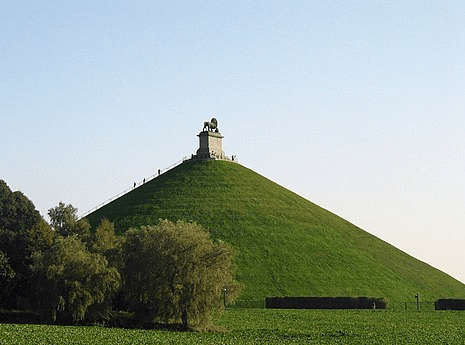
When Napoleon lost his last battle – the battle of Waterloo, it changed the course of history and provided a metaphor for resounding and irreversible defeat. “Meet one’s Waterloo” means to be decisively defeated after a run of success. But the French emperor did not meet his Waterloo in Waterloo, the battle was fought 3 miles south of Waterloo village ( 9 miles south of Brussels) in the villages of Braine-I’Alleud and Plancenoit. The most famous memorial of this battle- a lion statue atop a manmade hill- is also located at Braine-I’Alleud. King William I of Netherland built it in 1820 on the spot where he believed his son the Prince of Orange had been wounded. The battle got its name because the commander of the British army, the Duke of Wellington, wrote his official report of the battle from his Waterloo headquarters.


 Pages from History