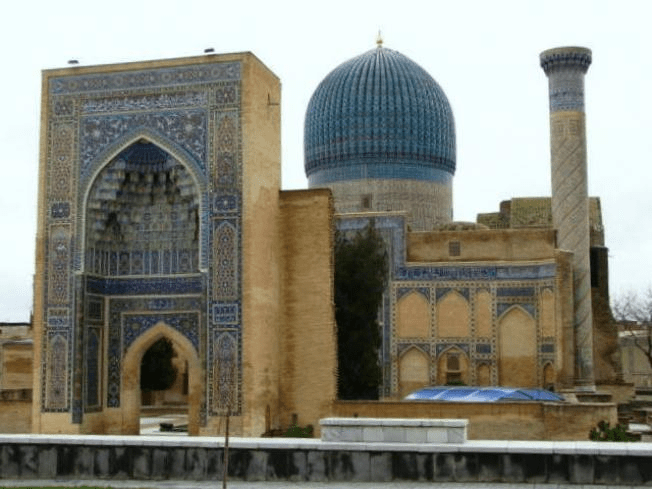
While trying for pawn promotion in a chess game, one of the inscriptions on the tombstone of Timur that says “When I Rise from the Dead, The World Shall Tremble”, flashed in my mind and provided me the theme for this blog.
Timur (1336 – 1405) was a Turco-Mongol conqueror, the ferocious and terrifying founder of the Timurid Empire in Persia and Central Asia, chiefly remembered for the barbarity of his conquests. He is better known by his byname ‘Timur-i-lang’. The name Timur-i-lang means Timur the Lame, a title of contempt used by Persians, which became Tamburlaine in Europe. Timur belonged to a Mongol tribe known as Barlas that had settled in Transoxiana after taking part in Genghis Khan’s son Chagatai’s campaign in that region. Unlike their nomadic ancestors, the Barlas were settled agriculturalists and traders.
The historical sources leave us in no doubt that Timur had a severe injury in his right leg which made him walk with a limp. Despite this disability, Timur rose to become one of the greatest conquerors of all time and he is often compared with Genghis Khan and Alexander. Timur was not of royal blood and came from humble stock. His bravery and martial skills made him a successful mercenary soldier in Persia and he soon collected a large following of his own. By 1366, Timur along with his brother-in-law Amir Hussein controlled Transoxiana. In 1370, he assassinated Amir Hussein and declared himself sovereign of the region and restorer of the Mongol empire. From here, he went on to create one of the most extensive military empires in the medieval period which incorporated, in addition to Transoxiana and Khwarazm, the regions around Caspian Sea, Iran, Iraq, part of the Southern Caucasus and the territory of present day Afghanistan and northern India.
Timur’s military campaigns were carried out with ruthless vigour and extreme barbarity. His victories were invariably followed by sacking of cities, massacres and towers built of human skulls. However, he was viewed favourably in the west for his defeat of Bayezid I, the Ottoman Sultan from 1389-1402. Bayezid I had expanded his empire into Southeast Europe, and had inflicted crushing defeat on crusaders at the battle of Nicolopolis. He had laid siege to Constantinople, the capital of Byzantine empire and had come close to capturing it. Therefore, not surprisingly, Timur was hailed as saviour of Christianity in the west after he defeated Bayezid I at the battle of Ankara in 1402.
Timur’s mission was to restore Mongol rule to the glory days of Genghis Khan. During his time, China was ruled by Ming dynasty which had come into power overthrowing Mongol Yuan dynasty. Timur saw them as usurpers. In early January 1405, he left Samarkand accompanied by a huge army to take China back from the Ming dynasty. The harsh winter that year took its toll on ageing Timur and he died at Otrar, a city in Kazakhstan. His body was brought back to Samarkand and buried at the Gur-i-Mir.
In 1941, Stalin sent a team under famous Soviet historian and anthropologist Mikhail Gerasimov to open Timur’s tomb and do a scientific study of it and to create a replica of what he looked like in real life based on the contours of his skull. Soviet team opened the tomb on June 20, 1942. Timur’s tomb had two inscriptions. The first inscription, written on the tombstone, says “When I Rise from the Dead, The World Shall Tremble”. The second one, located inside the tomb, says “Whosoever Disturbs My Tomb Will Unleash an Invader More Terrible than I’. Two days after opening of Timur’s tomb, Hitler invaded Soviet Union without formal declaration of war. Many people linked it with the opening of Timur’s tomb. The turning point in the Second World War came with a victory of the Soviets in the Battle of Stalingrad. A month earlier Stalin had ordered to return the remains of Timur to Samarkand and to bury them with full honours. Those who believed in the curse of Timur’s tomb, link this victory with returning the remains of Timur to his tomb. Although these events are mere coincidences, the legend persists due to the superstitious nature of human beings.


 Pages from History