Nero was the last emperor of Rome belonging to the Julio-Claudian dynasty. His mother was Agrippina (the younger) and Nero was her son from her first marriage to Gnaeus Domitius Ahenobarbus. Agrippina was a woman of boundless ambition with no qualms. She married her uncle Claudius ( brother of her father Germanicus) when he became emperor after the assassination of Caligula (Caligula was brother of Agrippina). She had married Claudius with the sole purpose of dispatching him to a better world and install her own son on the throne of Rome. She got Nero married to Octavia, daughter of Claudius and then persuaded Claudius to declare Nero as his heir in place of his own son Britannicus. Despite having been declared heir, the succession of Nero was brought about by the crime of his mother. It was suspected that Agrippina killed Claudius by having him served poisonous mushrooms.
Upon the death of Claudius, Agrippina immediately had Nero declared emperor by the Praetorian Guards ( household troops of Roman emperors) who was not yet 17. She quickly eliminated all her major opponents and hoped to control government with Nero as her tool. Nero’s old tutor Seneca encouraged him to act independently and ultimately Agrippina was forced into retirement. However, she continued to wield some degree of authority and influence. Historians accuse Nero of matricide due to Agrippina’s opposition to his affair with Poppae Sabina who later became his second wife. Nero killed her also by kicking her in the belly when she was pregnant. Nero had earlier divorced, banished and then had his first wife Octavia killed by having had her suffocated in a steam bath. According to his biographer Suetonius, Nero indulged in every sort of obscenity, ranging from incest to cruelty to animals to cold blooded murder.
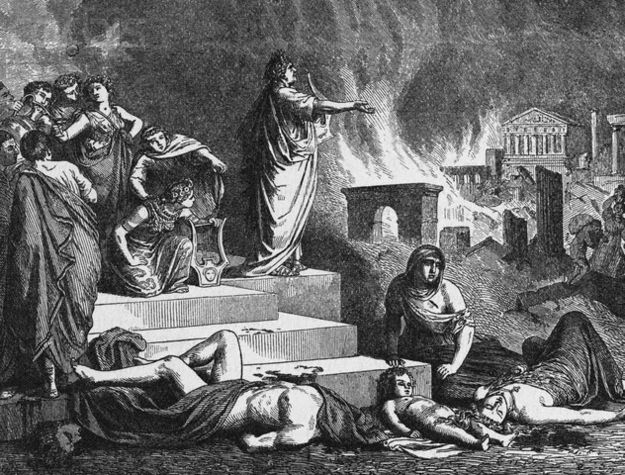
Nero is also blamed for the ‘Great Fire of Rome’ which started on July 18, 64 AD, in the enormous Circus Maximus stadium in Rome and legend states that the decadent and unpopular emperor Nero ‘fiddled’ whilst his city burned before him. When the fire was finally extinguished six days later, 10 of Rome’s 14 districts had burned. Historians say Nero wanted to raze the city so he could build a new palace. Before the fire, Nero had planned to knock down a third of Rome to erect a series of palaces and elaborate gardens adorned with monuments. The Senate rejected his plans, seemingly providing him with a motive to start the fire. After the fire, Nero had a new palace built on the ashes on of the burnt down buildings known as his ‘Golden House’. Given these circumstances and his long list of crimes, Roman historians had ample reasons to blame Nero for the ‘Great Fire of Rome’.
“Nero fiddles while Rome burns” has become a phrase used to criticize someone who is doing something trivial or irresponsible in the face of an emergency. The story goes that when the great fire swept across Rome, Nero climbed to the top of the city walls reciting lines from a now lost epic poem describing the conflagration that the Greeks had put to the fallen city of Troy. Historians tell us that he wore a theatrical garb on that occasion and played an instrument called cithara. Cithara was a forerunner of the lute which in turn gave rise to the modern guitar. “Fidicula” was the categorical term for all stringed instruments during the early Middle Ages from which the word ‘fiddle” derives. In short, Nero was blamed not only for putting Rome to fire but also for rejoicing and neglecting his people while they suffered.
In AD 68, Vindex, the governor of Gaul (France) and Galba, the governor of Spain rebelled against Nero. Troops loyal to Nero defeated Vindex but Galba started gaining more military support. Nero lost support of people of Rome due to a food shortage caused by a rebellious military commander who cut the crucial food supply from Egypt to Rome. Senate declared Nero an enemy of the people and the Praetorian Guards too abandoned him. Nero was forced to flee Rome and he committed suicide by stabbing himself in the throat.
Many modern historians consider Nero as a victim of propaganda started by his successors than as a self-obsessed tyrant who allegedly started the great fire of 64 AD. The basic rule of Roman history was that emperors who were overthrown and killed were demonized and those who were succeeded by their natural heirs were glorified. Most of what we know about Nero comes from the surviving works of three historians – Tacitus, Suetonius and Cassius Dio which where were written decades after Nero’s death. Nero’s demise was followed by a period of chaos and civil war – one that ended when Vespasian seized power and founded a new dynasty known as the Flavians. These historians writing under the Flavian rule had an interest in portraying Nero in the worst possible light in order to provide legitimacy to the new ruling family. Whatever may be the truth, the expression “Nero fiddled while Rome burned” is so deeply entrenched in popular thought that it is unlikely to get discarded by the refutations of modern historians.


 Pages from History