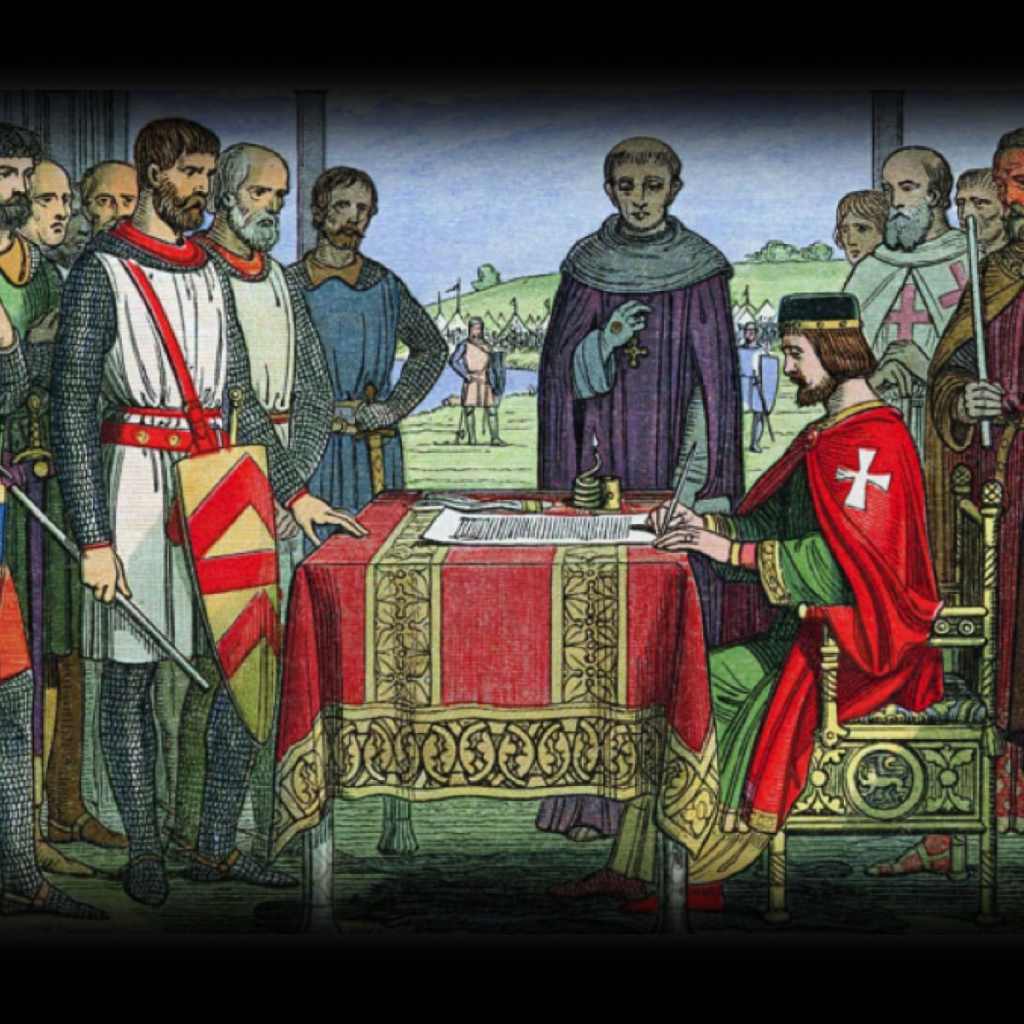
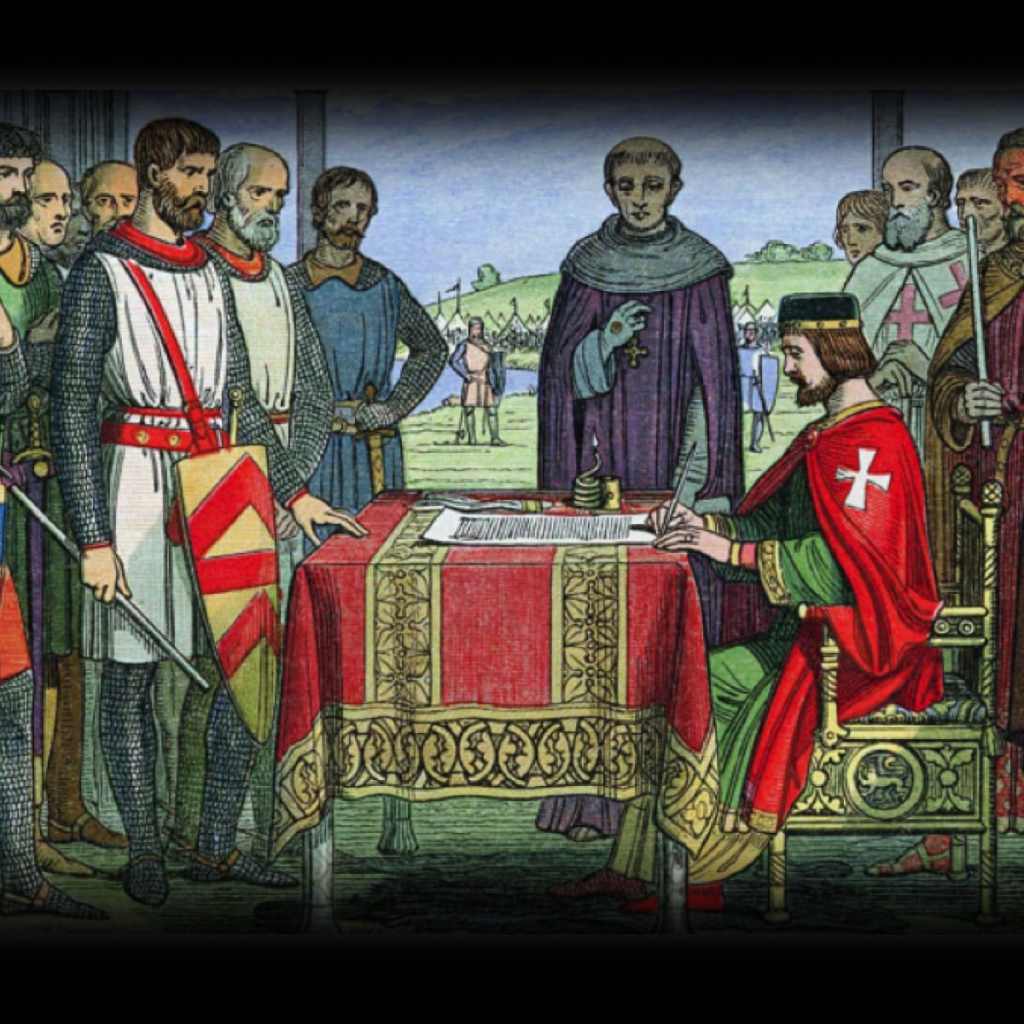
Magna Carta is a pathbreaking legal document that challenged the absolute powers of the monarchs and laid the foundations of individual liberty. On 15 June, 1215 King John of England had affixed his seal to Magna Carta in order to make peace with his rebellious barons and avert civil war.
John was crowned the king of England in 1199 CE and with his coronation he also became Duke of Normandy, Aquitaine and Maine in France which belonged to the royal family of England. In the year1200 CE King John divorced his first wife Isabella of Gloucester and married Isabella of Angouleme, even though she had been previously betrothed to a French nobleman Hugh de Lusignan. The Lusignan family appealed to King of France Phillip II who then confiscated all the French land belonging to King John which led to a war between England and France. Despite some initial successes, King John failed to recover his French land which dealt a damaging blow to his prestige. Military conflicts between England and France continued as King John persisted with his efforts to regain lost French land. After the loss of French land, King John was forced to rely on English resources alone which resulted in heavier tax burden and more frequent demand for scutage (money paid by a knight to commute the military service he owed). King John became increasingly unpopular with English barons.
Besides military defeats and heavy tax burden, there were several other reasons for John’s unpopularity, one of them being his strained relationship with Pope. He had refused to accept the election of Stephen Langton as Archbishop of Canterbury. In retaliation Pope Innocent III had put England under papal interdict* in the year 1208 CE and then excommunicated him in the year 1209 CE. Papal interdict was lifted and excommunication was withdrawn only when King John accepted Stephen Langton as Archbishop of Canterbury and surrendered his kingdom to the overlordship of Pope in the year 1213 CE.
The discontented barons saw their opportunity when King John returned to England humiliated and weakened after his defeat at the Battle of Bouvines against France in 1214 CE. However, barons did not have a successor in mind to replace King John and therefore, they continued to attack his oppressive rule claiming that he was not adhering to the ‘Charter of Liberty’. This charter had been issued by Henry I in the year 1100 CE which bound the King to certain rules regarding the treatment of church officials and nobles and was in many ways a precursor to Magna Carta. The dispute escalated when King John refused to meet barons’ demands and in May, 1215 barons renounced their oaths of allegiance to him, choosing Robert Fitzwalter as their leader. Capture of London by rebellious barons forced King John to negotiate with them. The demands of the barons were recorded in the document known as ‘Articles of the Barons’ and King’s seal was affixed to it on 15 June, 1215 in the meadow at Runnymede ( a place now in the county of Surrey). For their part, the barons renewed their oaths of allegiance to the king on 19 June, 1215. The formal document which was drafted by the Royal Chancery as a record of this agreement (there were several significant changes to the phrasing and order of the clauses contained in the Article of Barons) became to be known as the first version of the Magna Carta. This document was essentially a peace treaty but it contained several clauses designed to bring about reforms in judicial and local administration.
Magna Carta as a peace treaty proved to be a failure as the settlement between the King and his rebellious barons did not last long. King John persuaded Pope to annul the Magna Carta. In fact, Pope himself was alarmed by the terms of the charter and issued a document known as papal bull** declaring Magna Carta as “null and void of all validity forever”. In September, 1215 civil war broke out between the King and his barons and Magna Carta was effectively dead but it gained a new life when King Henry III issued its revised version in November, 1216 to regain the support of the barons. Magna Carta soon became a symbol in the fight against oppression and a defense against attack on individual liberty.
The Magna Carta signed in June 1215 contained 63 clauses, four of which are still valid as English law. Out of these four clauses, Clause 39 and 40 are famous and of enduring importance to people. They pertain to individual liberty and the right to justice. Magna Carta is regarded as the foundation of democracy in England. For the first time it established the principle that even the King was subject to the law. It was also for the first time that a ruling monarch had been forced to renounce a great deal of his authority. The fundamental values buried within Magna Carta are echoed in the constitution of the USA and many other modern democracies as well as in the Universal Declaration of Human Rights (1948) and the European Convention on Human Rights (1950).
* Papal Interdict – An interdict is a censure or prohibition excluding the faithful from participation in certain holy things. Papal interdict is an interdict issued by the Pope.
** Papal bull – A papal bull is a type of public decree, letters patent, or charter issued by the Pope. It is named after the leaden seal (bulla) that was traditionally appended to the end in order to authenticate it.


 Pages from History